Behind the build · Massimo Gaifa
Making a reading list into a way of thinking.
AI Theory Map brings my approach to customer success and practical AI adoption to a personal research problem: make complex information understandable, inspectable and useful for decisions.
Beyond this project
Turning information into a useful next step.
In my customer success and operations work, I use AI as a strategic-planning partner and to build tools that turn existing data into understandable, actionable workflows.
That work has helped me identify growth, churn and margin signals earlier, produce better-presented reports faster, and improve the quality and sophistication of Salesforce dashboards. I’ve demonstrated the benefits to the business and my team to build understanding, interest and adoption.
AI Theory Map brings that approach to a personal question: how can I make a complex body of information easier to inspect and reason about?
The problem
Keep the argument, not just the title.
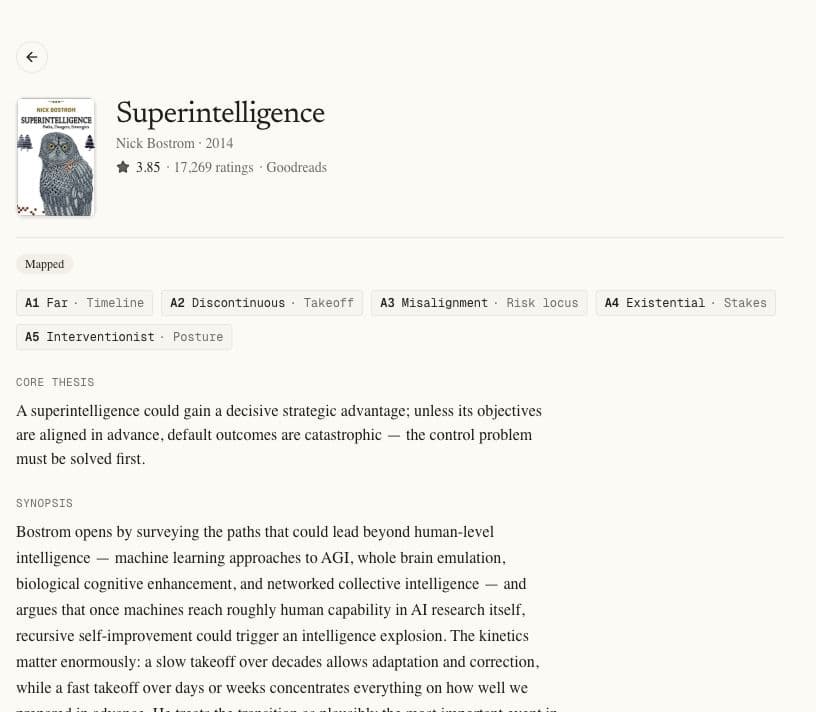
A growing reading list makes it easy to remember conclusions and lose the reasoning underneath. The map gives each reading a common structure while preserving its own thesis, assumptions and objections.
Product decision
Make disagreement specific.
Predictions, recommendations, assumptions and objections are separately inspectable. Two books can share an expectation about capability while disagreeing about control, coordination or the right response.
AI decision
Assistance with a visible trail.
AI helps with research and drafting. Draft labels and provenance remain visible, so a reader can inspect how an entry was produced. A mapped entry can still be an unread AI draft; mapping does not itself mean human verification.
Model decision
Expose the assumptions that move an outcome.
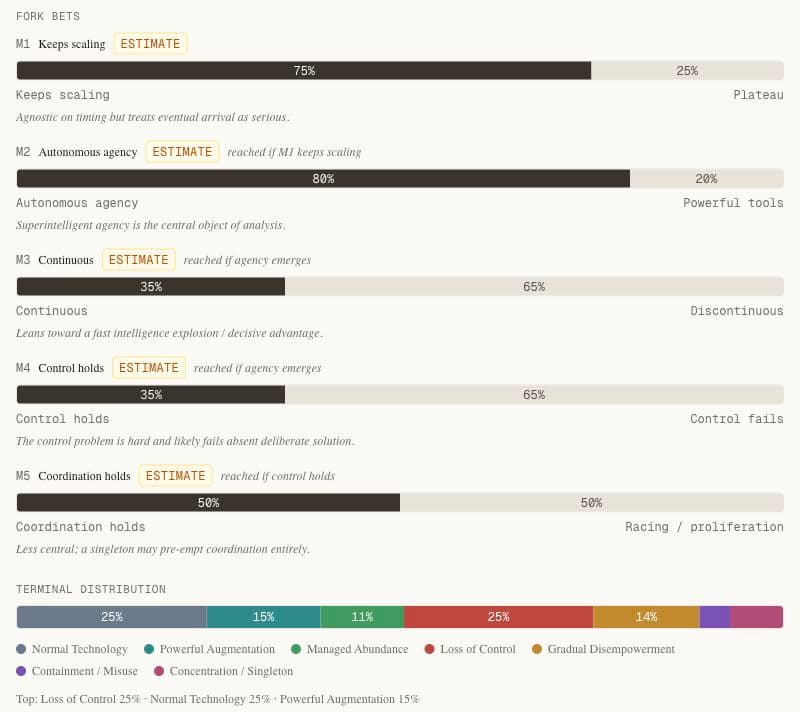
One tested implementation drives the scenario calculations. Sensitivity makes it possible to see how a changed assumption affects the result.
A portfolio of viewpoints retains separate readings before combining their outcomes. A blended viewpoint first combines assumptions. These are different operations, and the interface keeps the distinction visible.
Model probabilities are estimates under selected assumptions, not probabilities attributed to the authors or a claim of forecast accuracy.
Engineering
Make the underlying behavior dependable.
- Data isolation: readers’ personal maps stay scoped to their accounts.
- Atomic saves: related changes are committed together.
- Stale AI results: an outdated result cannot silently overwrite a newer draft.
- Quotas: online drafting respects configured limits and exposes failures.
- Deployment: the database migration to Neon preserved the existing application and its separate local workflow.
Technical details and online / local boundaries
- Application
- Next.js and TypeScript, hosted on Vercel.
- Identity & data
- Clerk handles identity; Neon provides Postgres.
- Online
- The shared compendium, personal maps and configured personal AI drafting through OpenRouter remain available under existing permissions and quotas.
- Local
- Claude Max through the Agent SDK supports the local workflow. Grounded full-text ingestion, Discover generation and Recall are local capabilities, not promised features of a new web account.